ESU LOKSOUND 73401 Alco Select Pin Sound Decoder Throttle 244
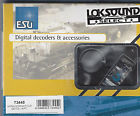
( Brand: Esu Loksound ), ( Manufacturer Part Number: 73401 ), ( Part Type: Decoder ), ( Power Supply: Dcc ), ( Voltage: 16 ), ( Gender: Boys Girls ), ( Country/region Of Manufacture: Germany ), ( Features: Sound Function )
Review ESU LOKSOUND Alco 244 Select Pin Sound Decoder Full Throttle
The 73401 ESU LOKSOUND Select Pin Sound Decoder Throttle is an advanced digital command control (DCC) decoder designed for use in model railroad layouts. This decoder is specifically for the ALCO RS-244 diesel locomotive, providing realistic and authentic sounds for this iconic train model.
The ESU LOKSOUND Select decoder offers a wide range of features, starting with its ability to produce high-quality, digitally recorded sounds for both diesel engines and electric motors. It includes 24 sound channels, allowing for a vast array of sounds and effects, from engine starts and stops to dynamic brakes and air horns. The decoder also supports multiple speeds, giving you precise control over your locomotive's movement.
One of the standout features of this decoder is its Select Pin function. This allows you to control multiple decoders on the same locomotive with a single throttle, providing a seamless and hassle-free experience. The decoder is also compatible with popular DCC systems, such as Digitrax, NCE, and Lenz.
The ESU LOKSOUND Select decoder is easy to install, with clear instructions included in the packaging. It features a robust design, with gold-plated contacts for reliable operation and a heat sink to dissipate heat, ensuring long-lasting performance.
In summary, the 73401 ESU LOKSOUND Select Pin Sound Decoder Throttle is an excellent choice for model railroad enthusiasts looking for a high-quality, feature-rich decoder for their ALCO RS-244 diesel locomotive. Its realistic sounds, Select Pin functionality, and compatibility with popular DCC systems make it a must-have addition to any model railroad layout.
Pros of buying 73401 ESU ALCO 244 LokSound Select Pin Sound Decoder Throttle:1. High-quality sound: ESU is known for its high-quality digital sound files and realistic sound effects, which will enhance the overall experience of operating your model train.
2. Plug-and-play compatibility: The decoder is easy to install and can be used with most DCC systems, including Lenz, Digitrax, and NCE.
3. Programmable features: The decoder allows you to program various functions, such as acceleration and braking curves, light control, and multiple engine addresses.
4. Advanced features: The decoder includes advanced features such as load compensation, which simulates the effect of additional weight on the wheels, and dynamic braking, which simulates the effect of air brakes.
5. Durable construction: The decoder is built to last and is designed to withstand the rigors of model train operation.
Cons of buying 73401 ESU ALCO 244 LokSound Select Pin Sound Decoder Throttle:1. Expensive: Compared to other sound decoders, the ESU decoder can be quite expensive.
2. Complexity: The decoder has a lot of features and options, which can be overwhelming for beginners.
3. Requires additional equipment: To use the decoder, you will need a DCC system and a compatible throttle.
4. Limited compatibility: While the decoder is compatible with most DCC systems, it may not work with all models or layouts.
Conclusion:If you are a serious model train enthusiast and want the best sound quality and advanced features, then the 73401 ESU ALCO 244 LokSound Select Pin Sound Decoder Throttle is a great investment. However, if you are a beginner or have a limited budget, you may want to consider other options with fewer features and a lower price point.
Recommendation:If you are looking for a high-quality sound decoder that offers advanced features and is easy to install, then the 73401 ESU ALCO 244 LokSound Select Pin Sound Decoder Throttle is a great choice. However, make sure to research your specific model and layout to ensure compatibility and consider the additional equipment and complexity that may be required to use the decoder.
Details:
Once this function button is pressed, the sound disengaged from speed. Once applied, the sound will drop to idle.
In emfs this is the point at which shaft-driven compressor reaches its second stage, and pumps air faster through train. When the button is pressed, motor will remain at a constant speed, while sound can be controlled independently from motion with throttle knob. With these settings the loco will drift or coast much further when brake is not applied.
This exciting, new feature gives the operator ability to have his or her train crawl in notch 8 coast at 50mph. By pressing the coast function button, sound drops from wherever you are to idle and remains there. Then, by applying the brake, loco will stop in a much shorter distance.
Loksound decoders now also have a working independent brake. There is no way for a decoder to know the proposed weight of cars it pulling. The run 8 feature will allow for exactly that.
Shipping: we gladly combine shipping and give actual rate based on weight. The payload inside a prototype car can weigh as much 100-tons more than itself.
This allows for the locomotive to stop more quickly than its regular momentum would normally carry it. Often when coming to a stop, the throttle of real locomotive is put into idle and engineer coasts stop.
This is especially important at operating sessions. It needs to stay at idle.
If your loco is not equipped with dynamic brakes please choose sound slot 21 coast for the on brake function button.
All of this can be done on the fly with hardly even thinking about it.
One of the biggest problems with emf controlled load is due to fact that in our model ING and operations we often simulate loads inside a closed car. As a note, you can now do standing brake tests by keeping the on and advancing throttle knob so sound of notch 4 be heard. To reduce shipping on multiple items shipped together.
Brake: along with dynamic brakes, a locomotive has an independent brake as well. But the new files will now work better when consisted together and using dynamic brake. While this will work with whatever deceleration settings are in the loco, it tends to more realistically if loco has a large amount of.
Once you release the button fan will shut off as prime mover drops again to idle. Some of this can be done with emf - when the loco feels a load, it will automatically rev up to work harder pull actual load.
This one is pretty self-explanatory just press the brake and come to a stop. But this is often a flawed method in model ING. If your loco does not have dynamic brakes you should still apply the brake logic when consisting so that engine slows with other brake-equipped locos in consist.
I only ship to a confirmed address. Using the throttle knob, you can now speed up or slow down train with sound remaining constant, at idle. The Esu dynamic brake has not really changed much with new added features. Simply press the button and prime mover will increase PMS from wherever you are, all way up to notch 8 hold.
Empties in and loads out or vice versa. Using the throttle knob you can now speed up or slow down with sound remaining constant, at full.
Drive hold: this feature allows the model er to easily simulate a loaded or empty train by adding single hold function button. This is not correct for non dynamic brake locos in a consist. No more switching between manual notching and programming on the main to go back forth.
Prototype locomotive dynamics will not work while stopped. Most emfs rise to about notch 4.
Another situation that occurs is once a train up to speed when operating over rolling terrain, the engineer can coast maintain certain. Then once the electricity dissipates from traction motors prime mover will rise depending on prototype. This series of new features includes drive hold, run 8 coast improved dynamic brakes and a independent brake feature.
Once the function button is pressed, sound disengaged from speed. Our car cards, showing whether a is loaded or empty, are seen only by the operator, not decoders. Dynamic brake: the Esu brake works like prototype.
You should not use the shift logic with non-dynamic brake locos. Today, model train car wheels are so free rolling that they often do not simulate sufficient drag to replicate a typical prototype situation.
This will have your loco drop the prime mover sound to idle while dynamic brake-equipped locos in consist go through brake cycles. Other brands will vary.
specifications dccsystemsacc:
- brand: Esu Loksound
- mpn: 73401
- part type: Decoder
- power supply: Dcc
- voltage: 16
- gender: Boys Girls
- country/region of manufacture: Germany
- features: Sound Function
General dccsystemsacc:
- in stock: Yes
- toys hobbies > model railroads trains toys hobbies > model trains dcc systemsaccessories
- condition: New
Offer dccsystemsacc:
- best offer: false
- bids: 0
- Sold: 0
- Started: May 14, 2017, 7:55 am
- quantity: 5
Shipping dccsystemsacc:
- cost: $0.0
- type: Flat
- handling: 1 days
Seller dccsystemsacc:
- zipcode: 27527
- city: Clayton, North Carolina
Payments dccsystemsacc:
- PayPal
Ratings:
- Beautiful looking locomotive. Haven't had time to run it. 05-09-17
- SMOOTH TRANSACTION, ITEM PACKAGED VERY WELL, VERY GOOD SELLER!!! 05-07-17
- SMOOTH TRANSACTION, SPEEEEDY DELIVERY, GOOD PACKAGING, A SELLER 05-07-17
- great item,shipped quickly,thanks much 05-09-17
- Great seller ,great products,fast delivery. 05-08-17
Returns dccsystemsacc:
- time: 30 Days
- policy: returns accepted
- paid by: Buyer
- type: Money Back
Esu Loksound 73401 Is Similar To:
- 50310 Esu Loksound Cabcontrol Wireless 4044645503102 (53.2% similar) For communicating with the outside world there is an USB port and a elan interface. When a new update becomes available it is as simple loading this to USB data stick and plugging in the back of system. As a result of this, many apps have been developed lately, which can be uploaded onto your mobile...(November 13th, 2017)
- 50340 Esu Loksound Modular Twin Speaker Baffle Set Sugar 4044645503409 (43.3% similar) The set contains two 2MM high and one 3MM intermediate frame. Do not open a return case for defective items, first, we'll work it out. Coupon code toward your next order. Its your choice. The minimum height is 6MM, which can be raised to 8MM, 9MM, 10MM, 11MM or 13MM by adding up three intermediate...(December 18th, 2018)
- 50341 Esu Loksound Modular Speaker Baffle Set Sugar Cube 4044645503416 (43.3% similar) The minimum height is 6MM, which can be raised to 8MM, 9MM, 10MM, 11MM or 13MM by adding up three intermediate frames. Speaker size: 11M x 15MM - 8 ohm with ESS new modular baffle set suitable for a single miniature you can easily assemble your tailor made the included. The set contains two 2MM ...(December 18th, 2018)
- 51800 Loksound Esu 51801 Switch 4044645518014 (38.9% similar) Recognition of control mode is fully automatic. For each servo, not only lever speed can be adjusted individually but also its end positions. The switch pilot servo would not be a typical Esu product, if it had even more to offer: you can operate decoder without use of command station. Thus it is ...(May 18th, 2017)
- 51952 Esu Loksound Usb Cable (58.2% similar) Don't believe so. Once an order has been packed and the shipping label printed, cancelling is same as a return. Do not open a return case for defective items, first. Its your choice. And are provided with a fetid chip required. Some even ship the same day...(January 5th, 2018)
- 5361 Esu Loksound Lokpilot Standard 4044645734452 (52.6% similar) To reduce shipping on multiple items shipped together. Shipping: we gladly combine shipping and give actual rate based on weight. I only ship to a confirmed address. Please e-mail any questions prior to buying...(December 20th, 2017)
- 54399 Esu Loksound New Dcc Decoder With Adapter Board 4044645543993 (42.6% similar) And Loksound l select decoders are made to fill a huge void in the o scale dcc market. Dcc decoder with adapter board factory sound Esu new 2018 Loksound l V4. Dcc decoder with adapter board factory sound 3 can be used on under amps the brand new Loksound l V4. Esu new 2018 Loksound l V4. And ...(October 6th, 2018)
- Universal 54500 4 Ready Loksound Sound Amp Xl V4.0 Programming Esu (29.8% similar) So model railroaders without a digital system can also enjoy the Loksound decoders, of course, without the sounds triggered by function keys. No matter which command station you operate, the decoder will always be perfectly integrated. 8v can be directly used due to an integrated voltage regulator...(February 8th, 2015)
- 54599 Esu New Loksound Xl Dcc Decoder Connect Factory 4044645545997 (44.7% similar) Decoders is the sound chip. Of course you'll be able to adjust all parameters with your command stations as are used do. Last but not least it should be remembered that the decoder can operated reliably with Selectric command stations. For the Loksound V4. M4 works with 8 polyphonic channels. You ...(April 13th, 2018)
- 54612 Esu Ho Lokpilot Multiprotocol Decoder Nib (37.8% similar) ...(October 7th, 2018)
- 54678 Esu New Smoke Generator Loksound Xl Or Susi 4044645546789 (42.2% similar) The steam exhaust plumes can be synchronised with external triggers or determined by Loksound XL decoder. Since we did not forget to include a temperature sensor the amount of smoke is independent track voltage . The amount of smoke and revs fan can be determined by Loksound XL V4. Besides sound ...(May 30th, 2018)