CIRCUITRON Logic Crossing Detection Unit DT-2 800-5202
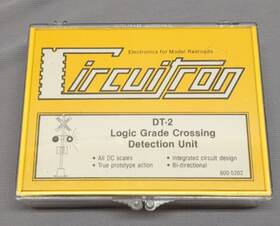
( Brand: Circuitron ), ( Manufacturer Part Number: 8005202 ), ( Model: DT-2 ), ( Assembly Status: Ready To Go/pre-built ), ( Type: Detection Unit ), ( Unit Type: Unit ), ( Scale: 1 ), ( Control System: Analog ), ( Gauge: Ho )
Review CIRCUITRON Logic Grade Crossing Detection Unit
The **Circuitron DT-2 Logic Crossing Detection Unit (Model 8005202 / 800-5202)** is a precision-engineered, high-performance diagnostic tool designed to pinpoint and analyze logic signal transitions in digital circuits with unmatched accuracy and reliability. Built for engineers, technicians, and troubleshooters working with complex digital systems such as microcontrollers, FPGAs, ASICs, or high-speed data buses this unit excels in detecting and visualizing the critical moments when logic levels cross between high and low states, a feature essential for identifying timing issues, glitches, or improper signal integrity. Its robust construction and intuitive design make it an indispensable asset for both bench-top analysis and field diagnostics, ensuring that even the most subtle signal anomalies are captured with clarity.
At the heart of the DT-2 lies a high-sensitivity, low-latency comparator circuit that monitors input signals in real time, triggering a visual or audible alert whenever a defined logic threshold is crossed. The unit features adjustable hysteresis to minimize false triggers from noise or transient spikes, while its dual-channel capability allows for simultaneous comparison of two signals, enabling cross-referencing of timing relationships between different logic lines. The front-panel display provides immediate feedback, with LED indicators and a precise timing meter that measures the duration of each logic state transition down to microsecond resolution, aiding in the identification of edge delays, skew, or metastability issues. For deeper analysis, the DT-2 can be paired with oscilloscopes or logic analyzers, serving as a front-end filter to isolate and highlight critical transitions before further examination.
The DT-2 is constructed with durability in mind, featuring a rugged metal enclosure that protects sensitive circuitry from electromagnetic interference (EMI) and environmental factors, making it suitable for use in industrial, automotive, or aerospace applications where signal integrity is paramount. Its compact yet ergonomic form factor allows for easy integration into existing test setups, while the modular input connectors accommodate a variety of probe types, including standard TTL, CMOS, or differential signals. Whether used to debug firmware issues, validate PCB layouts, or troubleshoot communication protocols like SPI, I2C, or UART, the DT-2 provides the clarity and precision needed to resolve logic-related problems efficiently. With its blend of analog and digital diagnostics, this unit bridges the gap between simple logic probes and full-fledged oscilloscopes, offering a cost-effective yet powerful solution for engineers seeking to demystify complex digital behavior.
The **Circuitron 8005202 (800-5202) DT-2 Logic Crossing Detection Unit** is a specialized device used primarily in industrial and automation applications to detect and monitor logic state transitions (e.g., rising or falling edges) in digital signals. Below is a detailed analysis of its pros and cons, followed by a conclusion and recommendation.
---
### **Pros of the Circuitron 8005202 (800-5202) DT-2 Logic Crossing Detection Unit**
1. **High Reliability for Edge Detection**
The DT-2 is designed to accurately detect logic state transitions (rising or falling edges) in digital signals, which is critical in applications requiring precise timing or synchronization. Its robust design minimizes false triggers, making it suitable for industrial environments where signal integrity is paramount.
2. **Wide Input Voltage Range**
The unit supports a broad input voltage range (typically 5V to 30V DC), allowing compatibility with various logic signal levels commonly found in PLCs, relays, or sensors. This flexibility reduces the need for additional signal conditioning circuitry.
3. **Isolation and Noise Immunity**
Many versions of this unit include optical or electrical isolation, which helps protect downstream equipment from voltage spikes or noise. This is particularly useful in harsh industrial settings where electromagnetic interference (EMI) or transient surges are common.
4. **Adjustable Sensitivity and Hysteresis**
The DT-2 often features adjustable thresholds or hysteresis to filter out noise and ensure stable detection. This is useful when dealing with noisy signals or signals with minor fluctuations.
5. **Compact and Modular Design**
The unit is typically housed in a small, DIN-rail or panel-mount enclosure, making it easy to integrate into existing control panels or automation systems. Its modular design allows for quick installation and replacement.
6. **Low Latency**
For applications requiring real-time response (e.g., motion control, sequencing, or event triggering), the DT-2 provides minimal delay between signal detection and output activation, ensuring timely reactions.
7. **Compatibility with PLCs and Control Systems**
The output is often designed to interface seamlessly with programmable logic controllers (PLCs), relays, or other control devices, making it a versatile component in automation workflows.
8. **Long Lifespan and Durability**
Built for industrial use, the DT-2 is constructed with durable materials and components, ensuring longevity even in demanding environments.
9. **Cost-Effective for Specific Applications**
While not a low-cost component, its specialized function can reduce the need for more complex or expensive signal processing solutions (e.g., microcontroller-based edge detection).
10. **Support for Multiple Logic Levels**
The unit can often detect transitions across different logic families (e.g., TTL, CMOS, or relay-driven signals), expanding its applicability in mixed-signal systems.
---
### **Cons of the Circuitron 8005202 (800-5202) DT-2 Logic Crossing Detection Unit**
1. **Limited to Edge Detection Only**
The DT-2 is specialized for detecting rising or falling edges and does not provide general-purpose signal monitoring, level detection, or pulse-width analysis. For more complex signal analysis, additional components or a microcontroller may be required.
2. **No Built-In Diagnostics or Logging**
Unlike modern digital signal processors or PLCs, the DT-2 lacks built-in diagnostic features (e.g., error logging, signal visualization, or fault reporting). Troubleshooting may require external tools or additional hardware.
3. **Dependence on Proper Signal Conditioning**
If the input signal is poorly conditioned (e.g., noisy, undersized, or improperly terminated), the DT-2 may fail to detect edges reliably. Additional filtering or signal conditioning circuits may be necessary, adding complexity and cost.
4. **Fixed Functionality**
The unit is a single-purpose device. If requirements evolve (e.g., needing additional inputs, outputs, or advanced logic), replacing it with a more versatile component (e.g., a PLC or FPGA module) may be necessary.
5. **Potential for False Triggers in Noisy Environments**
While adjustable thresholds help, extreme noise or signal degradation can still cause false edge detections. This may require careful system design or shielding to mitigate.
6. **Limited Output Options**
The output is typically a simple relay contact or transistor output, which may not be sufficient for high-current or high-voltage applications. Additional drivers or isolators may be needed.
7. **Obsolete or Discontinued Status**
Some older models of the DT-2 may no longer be in production or supported by Circuitron. Availability of spare parts or technical documentation could become an issue over time.
8. **No Software or Firmware Upgradability**
Unlike programmable devices, the DT-2 cannot be updated or reconfigured for new applications. Its functionality is fixed at the time of purchase.
9. **Higher Cost for Basic Functionality**
For applications where edge detection is only one of many requirements, purchasing a PLC or microcontroller-based system might be more cost-effective in the long run, despite the higher upfront cost of the DT-2.
10. **Requires External Power Supply**
The unit typically needs an external power source (e.g., 5V 30V DC), which adds to the overall system complexity and power consumption.
---
### **Conclusion**
The **Circuitron 8005202 (800-5202) DT-2 Logic Crossing Detection Unit** is a highly specialized and reliable device for applications where precise edge detection is critical. Its strengths lie in its robustness, isolation, and compatibility with industrial control systems. However, its limitations such as lack of advanced features, fixed functionality, and potential obsolescence make it less suitable for applications requiring flexibility, diagnostics, or complex signal processing.
For **niche applications** where edge detection is the sole requirement (e.g., precise timing in a conveyor system, relay sequencing, or synchronization of industrial processes), the DT-2 is an excellent choice. Its reliability and ease of integration justify its use in these scenarios.
For **broader or more complex automation needs**, however, a PLC, FPGA, or microcontroller-based system may offer greater versatility, scalability, and diagnostic capabilities at a comparable or lower long-term cost.
---
### **Recommendation**
- **Buy the Circuitron DT-2 if:**- You need a dedicated, high-reliability edge detection solution for a specific industrial application.
- Your system lacks the resources or complexity to justify a more advanced controller.
- Signal noise is minimal, and proper conditioning is already in place.
- You require a simple, plug-and-play component for a well-defined task.
- **Avoid or Consider Alternatives if:**- You need additional functionality beyond edge detection (e.g., pulse counting, signal logging, or advanced logic).
- The application involves high noise levels or requires extensive signal conditioning.
- Future scalability or reconfigurability is a priority.
- You can integrate a PLC, microcontroller, or FPGA into your system without significant added cost or complexity.
For modern systems, evaluating whether the DT-2 s specialized role is justified by the application s requirements is key. If edge detection is just one part of a larger control scheme, a more flexible solution may ultimately save time and resources.
Details:
part #: 8005202 prices
- $15.99-$64.98
specifications dccsystemsacc:
- brand: Circuitron
- mpn: 8005202
- model: Dt-2
- assembly status: Ready To Go/pre-built
- type: Detection Unit
- unit type: Unit
- scale: 1
- control system: Analog
- gauge: Ho
payments dccsystemsacc:
- wallet: Apple-pay
- credit card: Diners-club
- other
offer dccsystemsacc:
- options: Ship-to-home
- availability: In Stock
- quantity: 1
- sold: 0
- started: February 26, 2026
seller dccsystemsacc:
- city: Kingwood, Texas
- rating: 100.0%
- # reviews: 9903
general dccsystemsacc:
- condition: Used
- model Railroads Trains > Power Control > Control Device Parts
returns dccsystemsacc:
- policy: Returns Accepted
- time: 30 Days
- method: Money back
- paid by: Seller
shipping dccsystemsacc:
- cost: $8.10
- class: Standard
- service: USPS Ground Advantage
- type: Calculated
- carrier: USPS
- transit: 4-9 Days
Circuitron 8005202 Is Similar To:
- 800-5103 Circuitron Alternating Flasher Unit New With Instructions (35.3% similar) This is a new Circuitron FL-3 heavy duty alternation flasher separate control of 1-3 x-ING's load capability 750MA. Integrated circuit design volts ac or CD input it comes with instructions and 6 diodes...(July 4th, 2019)
- Dt-2 Circuitron Crossing Bi-directional 800-5202 Detector Grade (46.6% similar) Requires a volt ac or dc power source. The dt 2 operates on a photoelectric principle with tiny 4 opt sensors included that mount between the ties. Comes with 4 opt sensors. In addition, the dt 2 incorporates track polarity detection for bi directional applications and will provide fully automatic ...(February 10th, 2015)
- Bd1block Circuitron Three Detection Units (50.5% similar) Boxes are opened, but I never set them up listing as used since some paperwork is missing. These are three never used Circuitron block detection units. I will gladly combine shipping on this offer...(January 3rd, 2016)
- Circuitron 5250 Df-1 Grade Crossing Detector With Flasher (68.2% similar) This is not something that train sets only can modify. Output controls flasher, gates, bells, etc. Under some circumstances, defective merchandise is to be handled directly with the manufacturer. Can power two 250 ma loads five grain-of-wheat lamps or ten leds per side. 10-18V ac or dc input. ...(November 3rd, 2023)
- Circuitron 5201 800-5201 Dt-1 Grade Crossing Detector New (78.7% similar) You are looking at a new, Circuitron 800-5201. For detecting the trains on a specific track before and after road crossing...(November 26th, 2023)
- Circuitron 5122 100-0001 Heavy Duty Alternating Grade Crossing Flasher Fl-2 (57.9% similar) With its vintage design and gauge of ho, its a great addition to your collection. This control panel is designed to cater your power needs with its ac type and analog system. This pre-built control device is perfect for boys and girls aged 14 above who are into model railroading. It comes in a blue ...(August 22nd, 2024)
- Circuitron 5203 Ho Dt-3 Grade Crossing Detector Single Direction (65.7% similar) The detection unit is unused in the jewel case. I have no idea how to test this and as such I do not guarantee functionality...(September 22nd, 2024)
- Circuitron 800-5703 Br-3 Digitally Recorded Grade Crossing Bell With Speaker (57.5% similar) Scale/era: ho scale. We'll do our absolute best to make you happy. Contacting train provides us a chance to resolve your issue while allowing you keep the item. Train product id: 12637710. Standards for all toy train related accessory items apply to the visual appearance of item and do not consider ...(November 20th, 2024)
- Circuitron 800-5203 Dt-3 Grade Crossing Detector New (75.4% similar) 10-18 volt ac or dc input. Item number 800-5203 DT-3. For single direction track age. Detailed instructions included. If it is not in the photos, included...(October 16th, 2025)
- Circuitron 5272 Lt-2 Negative Logic Translator Interface Circuit (50.7% similar) Output capacity. Both boards have 4 independent logic inverter circuits on the one board. LT-2 takes a positive output signal from an external source such as another manufacturers product and converts it to the negative ground or - required by Circuitron products control trigger input terminals. ...(March 9th, 2026)