CYTGOUPER CYTGOUPER2254HJG Motor Forward Reverse Relay Delay YYB-5 12V 24V Module Timing
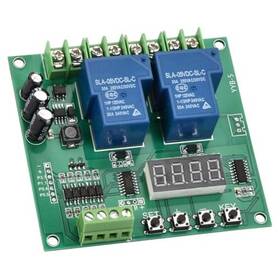
( Brand: Cytgouper ), ( Manufacturer Part Number: CYTGOUPER2254HJG ), ( Part Type: Motor Module ), ( Connector Type: Screw ), ( Contact Type: 2no 2nc ), ( Current Rating: 30 Amps ), ( Mounting Type: Panel Mount ), ( Operation Mode: Manual ), ( Wattage: 360 Watts ), ( Coil Voltage: 7 Volts ), ( Contact Material: Silver Alloy ), ( Included Components: 1 X Motor Control Board ), ( Specification Met: Rohs )
Review CYTGOUPER 12v 24v Motor Forward Reverse Relay Module Two way Relays Delay Timing
The **Cytgouper CYTGouper2254HJG YYB-5 12V/24V Motor Forward/Reverse Relay Module** is a high-performance, dual-channel relay controller designed to provide precise and reliable switching for motorized applications requiring bidirectional control with adjustable timing and delay functionality. This compact yet robust module integrates two independent **SPDT (Single Pole Double Throw) relays**, each capable of handling up to **5A at 250VAC or 30VDC**, making it ideal for a wide range of industrial, automotive, and DIY automation projects. The relay contacts are rated for frequent switching cycles, ensuring durability and longevity even under heavy-duty conditions, while the **NO (Normally Open) and NC (Normally Closed) configurations** offer flexibility for both forward and reverse motor control, allowing seamless reversal of rotation without the need for additional components.
One of the standout features of this relay module is its **built-in timing and delay functionality**, which enables programmable delays before activation or deactivation of the relays. This is particularly useful for applications requiring soft starts, gradual acceleration, or synchronized control sequences, such as in robotics, conveyor systems, or motorized valves. The module includes **adjustable timing controls**, typically accessible via onboard potentiometers or external inputs, allowing users to fine-tune response times from milliseconds to several seconds, depending on the specific requirements of the application. This level of customization ensures smooth operation and prevents sudden jolts or mechanical stress on connected motors or loads.
The **12V or 24V DC power compatibility** of this relay module makes it versatile for integration into low-voltage control systems, whether in embedded electronics, PLC (Programmable Logic Controller) setups, or standalone automation projects. The module is designed with **low power consumption**, ensuring minimal heat generation and efficient operation even during prolonged use. Additionally, its **compact and modular form factor** allows for easy installation in confined spaces, such as within enclosures, on breadboards, or directly on circuit boards, making it a practical choice for both prototyping and permanent installations.
Safety and reliability are prioritized in the design of this relay module, with features such as **overload protection** and **thermal shutdown mechanisms** to prevent damage from excessive current or overheating. The **optically isolated inputs** further enhance safety by eliminating the risk of electrical interference or ground loops, making this module suitable for use in sensitive electronic environments. Whether used for controlling DC motors in a robotics project, reversing the direction of a pump in a plumbing system, or implementing delayed start sequences in an automated manufacturing line, the **Cytgouper CYTGouper2254HJG YYB-5 Relay Module** delivers a blend of precision, flexibility, and durability that meets the demands of modern automation and control systems.
### **Pros and Cons of Buying a 12V/24V Motor Forward/Reverse Relay Module (e.g., CYTGouper CYTGouper2254HJG, YYB-5, or Similar Two-Way Relays with Delay/Timing)**
#### **Pros**
1. **Versatility in Motor Control**
- Allows precise control of DC motors (12V/24V) with forward, reverse, and stop functions, making it useful for robotics, automated systems, and hobbyist projects.
- Some models include built-in delay or timing functions, enabling automated sequences (e.g., timed motor activation).
2. **Compact and Modular Design**
- Typically small and easy to integrate into existing circuits, saving space compared to discrete relay setups.
- Often includes mounting holes or a PCB layout for easy installation.
3. **Protection Features**
- Many modules include overcurrent protection, preventing damage from short circuits or motor overloads.
- Some have built-in diodes (flyback diodes) to protect against voltage spikes when motors are switched off.
4. **Low Power Consumption**
- Operates efficiently with minimal standby power, making it suitable for battery-powered applications.
5. **Cost-Effective for Small Projects**
- Generally affordable compared to dedicated motor controllers, especially for simple applications like automated doors, conveyor systems, or hobbyist robots.
6. **Easy to Use**
- Requires minimal wiring just connect power, motor, and control signals (e.g., Arduino, PLC, or manual switches).
- Some models include LED indicators for status monitoring.
7. **Compatibility with Microcontrollers**
- Designed to work with Arduino, Raspberry Pi, and other microcontroller platforms via digital pins, simplifying automation tasks.
8. **Adjustable Delay/Timing Options**
- Models with timing features allow for programmable delays (e.g., auto-reverse after a set time), useful for cyclic operations.
---
#### **Cons**
1. **Limited Current Handling**
- Most consumer-grade modules (e.g., CYTGouper, YYB-5) are rated for **low current** (typically **10A 20A max**), which may not be sufficient for high-power motors (e.g., 30A industrial motors).
- Overloading can cause overheating or failure; always check the **continuous current rating**.
2. **No Built-in Braking or Regenerative Control**
- Unlike dedicated motor controllers (e.g., H-bridges with braking diodes), these modules do not provide **regenerative braking** or **coasting**, which can be critical for applications requiring smooth stops.
3. **Potential for Mechanical Wear**
- Relays have a **finite lifespan** (typically **100,000 1,000,000 operations**), especially under heavy loads or frequent switching. This may require replacement over time.
4. **No Built-in Overvoltage Protection**
- Some modules lack **reverse polarity protection** or **transient voltage suppression (TVS)**, which could damage the relay if power is connected incorrectly or surges occur.
5. **Limited Precision for High-Speed Control**
- Relay switching introduces **mechanical delay** (a few milliseconds), which may not be ideal for **high-speed motor control** (e.g., servo-like precision).
- For **PWM or speed control**, an external H-bridge or dedicated driver (e.g., L298N) is often better.
6. **Heat Dissipation Concerns**
- Running near the **maximum current rating** can cause the relay to overheat. Adequate ventilation or heatsinks may be needed in continuous-duty applications.
7. **No Built-in Feedback or Encoder Support**
- Unlike advanced motor drivers, these modules do not support **encoder feedback** or **closed-loop control**, limiting their use in precision applications.
8. **Potential for Noise in Analog Signals**
- Relay switching can introduce **electrical noise**, which may interfere with sensitive analog sensors or signals in the same system.
9. **Dependence on External Power Supply**
- Requires a stable **12V/24V power source**; fluctuations or poor grounding can affect performance.
10. **Limited Brand Reliability (Counterfeit Risk)**
- Some sellers (especially on platforms like AliExpress) may offer **counterfeit or low-quality replicas**, leading to inconsistent performance or early failure.
- Reputable brands (e.g., Omron, Schneider) are more reliable but cost significantly more.
---
### **Conclusion**
This type of **12V/24V motor forward/reverse relay module** is an **excellent choice for hobbyist projects, simple automation, and low-to-medium current applications** where cost and ease of use are priorities. It excels in:
- Basic motor control (forward/reverse/stop).
- Timed or delayed operations.
- Integration with microcontrollers (Arduino, Raspberry Pi).
- Low-power or non-critical industrial applications.
However, it is **not ideal** for:- High-power motors (check current ratings carefully).
- Applications requiring **precise speed control, braking, or encoder feedback**.
- Long-term industrial use without maintenance (relay lifespan matters).
- Systems where **electrical noise or reliability** is a concern.
---
### **Recommendation**
- **Buy if:**- You need a **simple, cost-effective solution** for a **low-to-medium current motor** ( 20A).
- Your project involves **basic automation** (e.g., garage doors, conveyor systems, robotics).
- You are working with **Arduino/Raspberry Pi** and need a plug-and-play relay.
- You can **monitor current draw** and ensure the relay operates within its limits.
- **Avoid if:**- You require **high current (>20A)** or **industrial-grade durability**.
- Your application needs **PWM speed control, regenerative braking, or encoder feedback**.
- You are working with **high-speed or precision motor systems** (consider an H-bridge like L298N or DRV8871 instead).
- You cannot verify the **authenticity of the module** (stick to trusted sellers).
- **Alternatives to Consider:**- **For higher currents:** Use **separate relays** (e.g., Omron G2R) or a **dedicated motor driver** (e.g., L298N, TB6612FNG).
- **For speed control:** Use an **H-bridge module** with PWM support.
- **For industrial use:** Opt for **solid-state relays (SSR)** or **PLC-compatible motor controllers**.
- **Safety Tips:**- Always **check the current rating** and ensure it matches your motor s requirements.
- Use **proper wiring** and **fuses** to prevent overloads.
- If using with microcontrollers, add **snubber circuits** to reduce relay bounce noise.
- For critical applications, **test the module** before full integration.
---
**Final Verdict:** This relay module is a **great budget-friendly option for beginners and simple projects**, but for advanced or high-power needs, a more specialized controller is recommended.
Details:
Fast Delivery.
part #: cytgouper2254hjg prices
- $27.31-$30.75
specifications dccsystemsacc:
- brand: Cytgouper
- mpn: Cytgouper2254hjg
- part type: Motor Module
- connector type: Screw
- contact type: 2no 2nc
- current rating: 30 Amps
- mounting type: Panel Mount
- operation mode: Manual
- wattage: 360 Watts
- coil voltage: 7 Volts
- contact material: Silver Alloy
- included components: 1 X Motor Control Board
- specification met: Rohs
payments dccsystemsacc:
- wallet: Google-pay
- credit card: Discover
- other
offer dccsystemsacc:
- availability: In Stock
- quantity: 1
- sold: 0
- options: Ship-to-home
- started: April 7, 2026
seller dccsystemsacc:
- rating: 99.9%
- # reviews: 981
- city: Miami, Florida
shipping dccsystemsacc:
- type: Fixed
- transit: 3-8 Days
- class: Expedited
- service: Expedited
- cost: $0.00
general dccsystemsacc:
- condition: New
- model Railroads Trains > Power Control > Control Device Parts
returns dccsystemsacc:
- policy: No Returns