NCE DCC NCE0283 Bus Wire Feet Awg 524-283
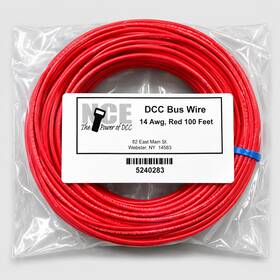
( Brand: Nce Dcc ), ( Manufacturer Part Number: NCE0283 )
Review NCE DCC Main Bus Wire Red 100 Feet Awg
The **NCE NCE0283 524-283 Bus Wire, 14 AWG, 2 Feet** is a high-performance, pre-terminated bus wire designed for precision and reliability in industrial automation, control systems, and electrical applications. Engineered to meet stringent industry standards, this wire features a robust **14 American Wire Gauge (AWG)** conductor, providing an optimal balance between current-carrying capacity and flexibility. With a **2-foot length**, it offers a compact yet versatile solution for connecting components in tight spaces, such as PLCs, sensors, actuators, and other control panel wiring. The wire is constructed with a **tinned copper conductor**, ensuring excellent conductivity and resistance to corrosion, which extends the lifespan of connections and minimizes signal degradation. Its **pre-terminated ends** feature a clean, crimp-style termination, making installation quick and efficient without the need for additional tools or soldering. Ideal for applications requiring stable power distribution or signal transmission, this bus wire is built to withstand frequent mechanical stress while maintaining signal integrity. Whether used in manufacturing automation, HVAC systems, or industrial control environments, the NCE0283 delivers dependable performance, making it a trusted choice for professionals seeking durability and ease of integration.
### **Pros and Cons of Buying 524-283 Bus Wire (14 AWG, 100 Feet)**
#### **Pros:**1. **High Current Capacity** 14 AWG wire is suitable for moderate current applications (up to 15 amps per conductor, depending on insulation and environmental conditions). This makes it a practical choice for bus wiring in automotive, industrial, or DIY electronics projects where power distribution is required.
2. **Flexibility and Durability** The wire is likely to be flexible enough for routing in tight spaces, reducing installation challenges. High-quality insulation (such as PVC or Teflon) ensures resistance to abrasion and environmental factors like moisture, oil, or temperature fluctuations.
3. **Cost-Effective for Bulk Use** Purchasing a 100-foot spool is economical compared to buying shorter lengths individually. This is ideal for large-scale wiring projects where multiple connections are needed.
4. **Compatibility with Common Applications**
- **Automotive Bus Wiring:** Suitable for CAN bus, LIN bus, or other low-voltage signaling in vehicles.
- **Industrial Control Systems:** Can be used for sensor wiring, motor control, or data transmission in machinery.
- **DIY Electronics:** Useful for prototyping or permanent installations in hobbyist projects (e.g., Arduino, Raspberry Pi peripherals, or custom PCBs).
5. **Easy to Terminate** 14 AWG wire is straightforward to strip, crimp, solder, or connect to terminals, connectors, or bus headers. Pre-terminated options (e.g., with spade lugs or IDC connectors) may be available for convenience.
6. **Standard Gauge for Many Standards** 14 AWG aligns with common wiring standards (e.g., SAE J1127 for automotive wiring), ensuring compatibility with off-the-shelf connectors and harnesses.
7. **Long Length for Future-Proofing** A 100-foot spool provides extra wire for unexpected routing changes or expansions, reducing the need for additional purchases.
---
#### **Cons:**1. **Limited Current for High-Power Applications** While 14 AWG can handle 15 amps in ideal conditions, it may overheat or degrade under sustained high-current loads (e.g., powering motors or high-wattage LEDs without proper fusing or cooling). For such cases, thicker gauges (e.g., 12 AWG or 10 AWG) are recommended.
2. **Potential for Signal Degradation in Long Runs** In high-frequency or sensitive applications (e.g., differential signaling, analog circuits, or long bus runs), 14 AWG may introduce resistance or capacitance issues, leading to noise or signal loss. Shielded or twisted-pair wire may be necessary for critical data lines.
3. **Vulnerability to Physical Damage** Thin insulation can be punctured or abraded during installation, especially in harsh environments (e.g., under car panels, near sharp edges, or in outdoor settings). Protective sleeves or conduit may be required.
4. **Crime Risk in Outdoor/Exposed Installations** If used in unsecured locations (e.g., outdoor wiring), 14 AWG is thin enough to be cut or damaged by animals, weather, or vandalism. Armoring or burial may be needed for outdoor applications.
5. **Compatibility Issues with Some Connectors**
- Some high-current or high-density connectors (e.g., automotive relays or industrial terminals) may require thicker wire (e.g., 12 AWG) to ensure secure connections and low resistance.
- Poor-quality connectors or improper crimping can lead to intermittent connections or fires.
6. **Flammability Concerns** PVC-insulated wire (common in 14 AWG) can melt or drip when overheated, posing a fire hazard in enclosed spaces. Fire-resistant or low-smoke insulation (e.g., Teflon or silicone) may be preferable in safety-critical applications.
7. **Potential for Overcrowding** In dense wiring harnesses (e.g., automotive wiring looms), 14 AWG can become tangled or difficult to manage alongside thicker wires or cables. Proper labeling and bundling are essential.
---
### **Conclusion:**The **524-283 14 AWG bus wire (100 feet)** is a versatile and cost-effective choice for **moderate-current power distribution, automotive bus wiring, or general-purpose electronics projects** where signal integrity is not critical. It strikes a balance between flexibility, cost, and performance for applications like:
- CAN/LIN bus wiring in vehicles.
- Sensor or actuator wiring in industrial control systems.
- DIY electronics (e.g., Arduino, Raspberry Pi, or custom PCBs).
- Low-voltage power distribution in hobbyist projects.
However, it is **not ideal** for:- High-current applications (e.g., powering motors, high-wattage LEDs, or heavy-duty machinery without additional protection).
- Long or high-frequency signal runs where noise or signal degradation is a concern.
- Outdoor or exposed installations without proper protection.
- Safety-critical applications where fire resistance is paramount.
---
### **Recommendation:** **Buy this wire if:**- You need a **reliable, mid-range gauge** for **automotive bus wiring, general electronics, or light industrial control**.
- You re working on a **budget-conscious project** where bulk wire (100 feet) is practical.
- Your application involves **currents under 15 amps** and **short signal runs** (under 10 20 feet).
- You plan to **terminate it properly** (e.g., with crimp connectors, spade lugs, or IDC headers) to avoid loose connections.
**Avoid or supplement with thicker wire if:**- Your project requires **higher currents** (e.g., 20 amps) Use **12 AWG or 10 AWG**.
- You re dealing with **long or high-speed signal lines** (e.g., differential pairs, analog circuits) Consider **shielded or twisted-pair wire**.
- The installation is **outdoor, exposed, or high-risk** Use **armored cable, conduit, or fire-resistant insulation**.
- You re working in a **high-vibration environment** (e.g., automotive engine bays) Opt for **braided or flexible shielding**.
**Alternatives to Consider:**- **12 AWG Wire:** Better for higher currents (up to 20 amps) and more durable for heavy-duty applications.
- **Shielded 14 AWG:** If signal integrity is critical (e.g., for sensitive sensors or long bus runs).
- **Pre-Terminated Harnesses:** If you need **ready-to-install bus wiring** (e.g., for CAN bus in cars).
**Final Verdict:**For most **moderate-power, general-purpose, or automotive bus wiring needs**, this 14 AWG wire is a **solid, cost-effective purchase**. Pair it with **proper connectors, fusing (if needed), and installation best practices** to ensure safety and reliability. If your project demands higher performance, scale up to a thicker gauge or specialized wire.
Details:
Specifications, length , and performance will match the listed product. This wire is perfect for connecting boosters to track feeders and supporting stable operation across small large layouts. Red color for polarity identification. Durable construction for long-term reliability.
Using heavy-gauge bus wire is essential for minimizing voltage drop and ensuring consistent power delivery to your track accessories. Helps minimize voltage drop across layout. NCE 524-283 DCC Main Bus Wire Red 100 Feet 14 AWG: The is a high-quality 14 AWG wire designed for reliable power distribution across your layout. Features: Genuine NCE DCC bus wire.
14 AWG for optimal current handling. The flexible insulation allows for easy routing under bench work while maintaining durability long-term use. Compatible With: NCE DCC systems. Perfect For: model railroaders building or expanding DCC layouts who need dependable, heavy-gauge wire for consistent and organized power distribution.
Flexible insulation for easy installation. Layout power distribution and bus wiring applications. 100-foot length . All NMRA-compatible DCC systems.
part #: nce0283 prices
- $52.07-$57.44
specifications dccsystemsacc:
- brand: Nce Dcc
- mpn: Nce0283
shipping Dccsystemsacc:
- service: USPS Ground Advantage
- carrier: USPS
- transit: 4-8 Days
- cost: $7.62
- type: Calculated
- class: Standard
payments Dccsystemsacc:
- credit card: Diners-club
- wallet: Google-pay
- other
offer Dccsystemsacc:
- availability: In Stock
- quantity: 7
- options: Ship-to-home
- sold: 0
- started: May 15, 2026
returns Dccsystemsacc:
- policy: No Returns
general Dccsystemsacc:
- model Railroads Trains > Power Control > Digital Control Devices
- condition: New
seller Dccsystemsacc:
- city: Tucson, Arizona
- rating: 100.0%
- # reviews: 1527
Nce Dcc NCE0283 Is Similar To:
- 52400207 52400207 Nce Cab Bus Fascia (27.7% similar) Nce UT panel cab bus fascia with RJ12 plugs is new in original package...(October 25th, 2017)
- 0025 Nce Any Scale Power Cab Complete Dcc Starter Set Everything (26.4% similar) There are no defects that I am aware of. If not paid and no communication from buyer automatically steps in. Gently used and in great condition. Ships to USA only...(April 9th, 2018)
- 0033586148132 Unbranded Nce Corporation Power Cab Dcc Starter Set (23% similar) Look at the pictures. He also got a power pro from Nce. I value my feed back been on since o6 of just don't want this to sit around, not being used. We agreed to let this go some one that wants get in awesome hobby. All new complete. Up for sale is a new power cab from Nce, bought my dad his ...(July 15th, 2018)
- 005240025 Nce Power Cab Dcc Control Starter Set Brand New (31.6% similar) This 2 system can operate up to 4 ho locomotives or 8 n scale. Installation is a snap. The power cab kit contains: cab, 7' cable, PCP panel, supply, pro coiled cord, and manual. You re off and running trains. Provides all of the capability and ease use that you ve heard about in our power pro system...(February 12th, 2019)
- 0115 Nce Power Cab Complete Dcc Starter Set Used As Store (29.8% similar) Milepost 38 toy trains armies model is the largest train on west coast. Largest selection of n, ho,on the west coast at discount prices. This is a complete set that was on display in the store. Box shows wear includes instructions. It is still new in the box and was never used on a layout. Shipping ...(October 17th, 2018)
- 0207 Nce Utp Cab Bus Fascia Panel For Dcc New (21.6% similar) ...(July 13th, 2018)
- 0212 Nce Power Cab Dcc Starter Set Version (30.3% similar) The pictures are part of , so please view them. C-3 poor requires major repair:heavily scratched, rust and missing parts. Nce power cab Dcc small dents, minor surface rust. If the amount of offers is over 200. Restoration candidate. 28, CC7 images to up for offer is: Nce n or ho scale Dcc starter ...(October 15th, 2018)
- 0269 Nce Ho Dcc Layout (27.8% similar) Make sure to include your contact and order information when you return items. The train for this item is P12166890. 5m feeders connectors wire taps. Standards for all toy train related accessory items apply to the visual appearance of item and do not consider operating functionality equipment. ...(December 4th, 2017)
- 0291 Nce Ho 12-16 Awg (30.8% similar) We ll do our absolute best to make you happy. Asia and Australia: 49. Save 75 on shipping when combining this item with other eligible items from train. Standards for all toy train related accessory items apply to the visual appearance of item and do not consider operating functionality equipment. ...(December 4th, 2017)
- Pac Cab Nce 052400207 2 Panel Utp Nib Fascia Bus (34.3% similar) ...(December 20th, 2014)
- Booster Nce 05240031 5amp Dcc Smart System Sb3a (25% similar) For operation consult your power cab manual. The SB3A does not have a programming track output. The SB3A smart booster adds expanded and updated features to a power cab Dcc system. This manual covers only the addition and installation of the SB3A to a power cab system. It no longer needs to remain ...(February 6th, 2015)